IPTV providers have exploded in number across 2026 — and the consumer experience has suffered for it. Walk into any online conversation about streaming, search any related term on Google, browse any social media platform, and you’ll find dozens of services all claiming to offer the same things: 22,000+ channels, 4K UHD streaming, low prices, instant activation. The marketing has become so uniform that distinguishing a genuinely premium service from an amateur operation has become genuinely difficult for ordinary viewers.
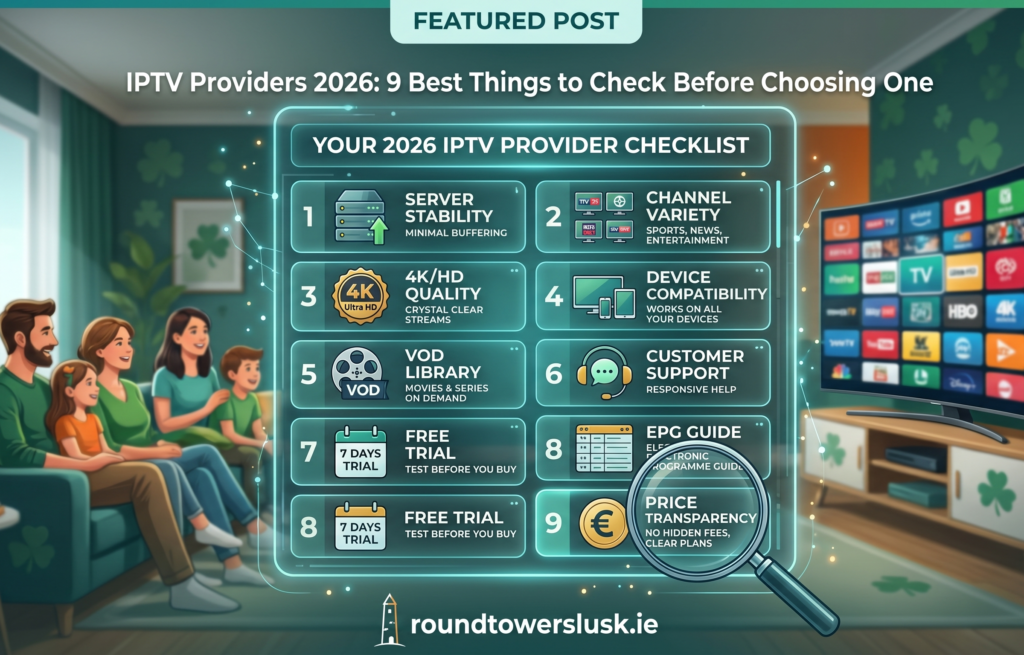
This guide gives you the 9 specific things every viewer should check before paying any provider in 2026. None of this is marketing fluff — these are the real technical, business and operational criteria that separate professional operations from short-term services that will frustrate you within weeks.
Key Takeaways
- The streaming market varies dramatically in quality despite nearly identical marketing claims — the real differences are invisible until you test them
- A free trial is non-negotiable in 2026 — any service refusing to offer one should be avoided immediately
- Server infrastructure location dramatically affects stream quality, particularly during peak viewing times
- Cryptocurrency-only payment is the strongest single red flag in the modern streaming market
- Verifiable business registration separates legitimate operations from anonymous resellers planning short-term setups
Why the IPTV Providers Market Has Become So Confusing
The number of streaming services worldwide has quadrupled since 2022, and the marketing across these operations has converged so completely that consumers genuinely struggle to distinguish quality from amateur work. Three forces created this situation:
1. Low barriers to entry. Anyone with a rented server, a payment page and €50 in advertising spend can launch a streaming service overnight. The result is hundreds of new operators entering the market each month — most of them planning short-term operations rather than long-term businesses.
2. Sophisticated marketing playbooks. The modern market uses identical advertising templates: same channel-count claims, same pricing tiers, same fake urgency tactics, same stock-photo testimonials. Telling them apart from genuine premium operations requires looking past the marketing layer.
3. Review manipulation. Trustpilot, Google Reviews and Facebook recommendations have all been heavily gamed in 2026. Fake reviews, paid testimonials and incentivised feedback have made it harder for consumers to rely on social proof alone.
The good news: legitimate operators can still be identified clearly using technical and business criteria the amateurs can’t fake. The 9 checks below will reliably separate genuine premium services from short-term scams.
How to Compare IPTV Providers: 9 Best Checks That Actually Matter
These are the genuine differentiators in the streaming market in 2026, ordered by importance.
Check 1: Does the Service Offer a Free Trial?
Any legitimate operation in 2026 offers a free trial — typically 24 hours of full feature access — without requiring payment information up front.
If a service refuses to offer a trial, treat that refusal as the single strongest warning sign in the market. Their typical excuses include:
- “We don’t offer trials because of fraud risk”
- “You can have a money-back guarantee instead”
- “Just buy one month and try it that way”
None of these excuses hold up. Quality operators are confident enough in their service to let customers test it freely. Refusal to offer a trial almost universally indicates the service can’t survive direct customer evaluation.
Check 2: Verify the Operator Has a Real Business Address
The single strongest predictor of service longevity is a verifiable business presence with a registered address. Anyone can rent a server and configure a payment page. Few amateur operators bother registering a real business because it creates accountability they specifically want to avoid.
Look for services with:
- A registered office address listed clearly on the website
- A registered company name searchable via official business registries
- Active social media presence with genuine customer interactions
- Customer reviews mentioning specific locations and personal details
A “company name” buried in fine print combined with a Gmail address is not a verifiable business presence — it’s an anonymous reseller setup.
Check 3: Test During Peak Viewing Times
The genuine stress test for any streaming operation is peak weekend evening viewing. Saturday and Sunday afternoons during major sport fixtures (Premier League, Champions League, NFL, boxing PPV nights) are when amateur services collapse most predictably.
Use your free trial specifically during these windows:
- Saturday between 3pm-6pm GMT during Premier League fixtures
- Sunday afternoons during major sport events
- Tuesday or Wednesday evenings during Champions League nights
- Major boxing PPV nights when streaming infrastructure peaks globally
If the service holds clean streams during peak demand, the underlying server infrastructure is genuinely premium. If it stutters, freezes or buffers during peak windows, the operator has either oversold their capacity or is running on amateur infrastructure that can’t handle real-world load.
Check 4: Check Channel Quality on Specific Channels You Watch
“22,000+ channels” marketing claims are meaningless on their own. What matters is whether the service actually streams cleanly on the specific channels your household watches.
Verify each major channel category specifically during your free trial:
- Local broadcasters — should be sharp HD, not blocky or out of sync
- Premium sports channels — should genuinely be in 4K, not upscaled HD
- International channels — audio sync is a common weakness in amateur setups
- News networks — should stream cleanly without buffering
- Kids and family content — should include modern children’s networks reliably
Channel count is meaningless. Channel quality on the channels you actually watch is everything.
Check 5: Confirm Premium IPTV Providers Use Tier-1 Servers
Premium operations run dedicated server networks based in major data centres — typically Frankfurt, Amsterdam, London, New York or Tokyo. This infrastructure proximity matters enormously for stream stability and 4K quality. According to Cloudflare’s network performance data, geographic proximity to a tier-1 data centre dramatically affects real-world streaming latency.
Ask any operator directly: “Where are your streaming servers based?” A legitimate one will answer immediately with specific data centre locations. An amateur reseller won’t know — because they’re just reselling capacity from a wholesale operator they don’t control.
Server location affects:
- Stream startup latency
- 4K stability during peak global viewing windows
- Match-day reliability when European or US traffic peaks
- Geographic redundancy if one data centre fails
Check 6: Review Customer Support Quality During the Trial Period
Test customer support before paying. Send a question through whatever channel the operator uses — typically WhatsApp, email or web ticketing for legitimate premium operations.
Note specifically:
- How quickly they respond to your initial question
- Whether they answer your actual question or send a generic templated reply
- Whether the response is in clear, professional language
- Whether they treat trial users with the same priority as paying customers
An operator that ignores trial users will ignore you faster after you’ve paid. Support responsiveness during the trial period is the strongest predictor of post-purchase support quality across the entire market.
Check 7: Verify Multi-Device Support Genuinely Works
Most streaming services advertise multi-device support — typically 2-3 simultaneous connections. Verify this works during your trial by:
- Setting up the trial credentials on your main Smart TV
- Setting up on a second device (Firestick, phone, tablet, Android box)
- Streaming on both simultaneously
If the second device immediately kicks the first off the network, the multi-device claim is misleading marketing. A genuine multi-device subscription from a premium operator supports concurrent streams without restriction.
Check 8: Check Payment Methods Offered
Legitimate operators in 2026 accept multiple standard payment methods:
- Credit and debit cards from Visa and Mastercard
- PayPal with full consumer protection
- Bank transfer including SEPA in Europe
- Modern payment apps (Revolut, Wise, Apple Pay, Google Pay)
- Optional cryptocurrency as one of multiple options
Services that only accept cryptocurrency are operating outside legitimate business frameworks. This payment model is preferred by operators who specifically want to avoid:
- Financial accountability
- Chargeback risk from dissatisfied customers
- Merchant account scrutiny from card processors
- Tax and regulatory reporting
Cryptocurrency-only payment is the strongest red flag in the modern market. Walk away immediately when you see it.
Check 9: Read Customer Reviews Carefully
Star ratings can be manipulated easily. The text of reviews is harder to fake convincingly. When evaluating reviews of any operator, look for:
- Specific locations mentioned by reviewers
- Specific channel names referenced in feedback
- Specific use cases described (live sport, family viewing, kids content)
- Reviews dated across multiple months rather than clustered in single weeks
- Mixed ratings rather than only 5-star or only 1-star feedback
Generic five-star reviews like “Great service, fast and reliable!” are almost universally fake. Detailed reviews from named customers with specific use cases are the genuine article when comparing options.
When Premium IPTV Providers Are Worth Paying More For
Three scenarios where stepping up from budget services to premium operations genuinely pays off:
Heavy live sport viewing. Premium operators invest specifically in match-day server capacity. Budget operations consistently fail at the highest-demand windows. If you watch Premier League, NFL, Champions League or boxing PPV regularly, the price difference is worth it.
4K UHD picture quality matters to you. True 4K streaming requires premium server bandwidth that budget services can’t sustain. The difference between genuine 4K UHD and upscaled HD is dramatic on modern Smart TVs, according to the Digital Cinema Initiatives 4K specifications.
You value customer support responsiveness. Premium operations maintain 24/7 support teams that respond within minutes. Budget services typically use shared support pools that respond in days, if at all.
For everyone else — light entertainment viewers, primarily on-demand watchers — budget services may genuinely deliver adequate streaming experience.
Common Mistakes When Comparing IPTV Providers
Three buying mistakes account for most disappointment in the streaming market:
Choosing based on advertised channel count alone. Most services claim “22,000+ channels” because that’s the industry-wide marketing template. What matters is whether your specific 25-30 most-watched channels are included and stream cleanly. A service with 30,000 channels is worthless if your favourite channels are missing or buffer.
Believing heavily advertised services are automatically better. Ad spend doesn’t correlate with service quality — it correlates with how aggressively the operator wants to acquire new customers before existing ones complain. Some of the most heavily promoted services on Facebook are also the lowest quality.
Skipping the trial because the price seems low. A €2/month service that collapses every weekend isn’t a bargain — it’s a waste of money plus the matches you wanted to watch. Premium operations cost €4-€12/month on annual plans for genuine infrastructure reasons.
How to Recognise Genuinely Premium IPTV Providers in 2026
Combining all nine checks above, here’s what a quality operator looks like in 2026:
- Free trial with no payment information required
- Transparent recurring pricing (no “lifetime” claims)
- Pricing between €4-€12 per month on annual plans
- Multiple payment methods including cards, PayPal, modern apps
- Responsive customer support (WhatsApp, email or web chat)
- Verifiable business registration with searchable records
- Server infrastructure based in tier-1 data centres
- Honest channel availability matching marketing claims
- Specific customer reviews mentioning real use cases
- No high-pressure sales tactics or fake urgency timers
Any operator passing all ten criteria deserves serious consideration. Services failing on two or more should be avoided regardless of advertised features or pricing.
Final Word on Choosing Between IPTV Providers
The streaming market in 2026 is more crowded and more confusing than ever, but recognising premium operations from amateur ones is still genuinely straightforward when you know exactly what to check. The 9 criteria above filter out 95%+ of the unreliable services in the modern market.
Take your time when choosing. Use free trials properly — during peak viewing windows, on the specific channels you watch. Verify business legitimacy independently. Test customer support response times before paying. Avoid cryptocurrency-only payment and Telegram-only support entirely.
For viewers in Ireland who’ve worked through this checklist and want to test an operator that meets every criterion above — free trial, multiple payment methods including Revolut and PayPal, verifiable Irish business presence in Athlone, WhatsApp support replying within 5 minutes, and 22,000+ channels with genuine European server infrastructure — the team at roundtowerslusk.ie offers a no-obligation trial so you can verify the service quality on your own setup before committing to anything. Whatever you choose, your subscription decision in 2026 should be based on verified performance, not marketing claims.