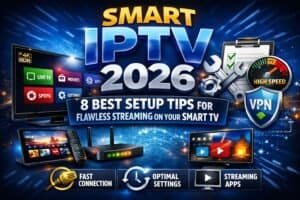
Smart IPTV is how most households now watch streaming content directly on their television — no extra box, no Firestick, just an app installed straight onto the Smart TV itself. It’s the simplest setup available in 2026, but it’s also the one most people configure badly. They install an app, paste in their details, and wonder why the picture buffers or the channels load slowly — when a handful of settings tweaks would have transformed the experience. Done properly, it’s genuinely excellent; done lazily, it disappoints.
This guide walks through the 8 best setup tips for running the service flawlessly on any Samsung, LG or Sony Smart TV in 2026. None of this is theoretical — these are the genuine configuration steps that separate a smooth setup from a frustrating one.
Key Takeaways
- The app runs directly on your Smart TV — no extra streaming device needed
- The most common mistake is relying on Wi-Fi when a wired Ethernet connection is dramatically more stable
- Samsung, LG and Sony each have their own app installation method
- A few hidden settings (hardware decoding, buffer size) make a major difference to stream quality
- Older Smart TVs may struggle with 4K playback — a dedicated streaming device can outperform them
What Smart IPTV Actually Means in 2026
The term smart IPTV refers to streaming content directly through an application installed on a Smart TV, rather than through an external device like a Firestick or Android box. It also commonly refers to a specific category of apps — including the well-known SIPTV player, IPTV Smarters Pro, and similar players — designed to run natively on Smart TV operating systems.
The appeal is simplicity:
- No extra hardware to buy or plug in
- No additional remote control to manage
- Everything runs through the TV you already own
- The app sits on your home screen like Netflix or YouTube
The trade-off is that Smart TV hardware is generally less powerful than a dedicated streaming device, so performance depends heavily on getting the setup and settings right. That’s where the following tips come in.
How to Set Up Smart IPTV: 8 Best Tips for Your Smart TV
Work through these eight tips in order for the smoothest possible experience on any modern Smart TV.
Tip 1: Choose the Right App for Your TV
Not all streaming apps perform equally. The best options in 2026, by platform:
- Samsung (Tizen): IPTV Smarters Pro, SIPTV, or Set IPTV — all available from the Samsung App Store
- LG (webOS): IPTV Smarters Pro or similar players from the LG Content Store
- Sony / Android TV: IPTV Smarters Pro or TiviMate from the Google Play Store (Android TV models have the widest app choice)
For most users, IPTV Smarters Pro is the best all-round option — clean interface, strong EPG support, and reliable playback. Avoid generic no-name apps that often have poor performance and unreliable updates.
Tip 2: Use a Wired Ethernet Connection (The Biggest Improvement)
This is the single most impactful change for stream quality. Smart TVs have weaker Wi-Fi chips than phones or dedicated streaming boxes, so they’re especially prone to buffering on wireless connections.
Every Smart TV has an Ethernet port on the back. Plug a standard Ethernet cable directly from your router into the TV. If you can’t run a cable across the room, powerline adapters (around €60 a pair) push Ethernet through your home electrical wiring.
The result:
- Buffering during peak viewing drops dramatically
- 4K streams become genuinely stable
- Standby/wake-up reconnection issues disappear
Tip 3: Switch Your Smart TV to a 5GHz Wi-Fi Connection
If wired Ethernet genuinely isn’t possible, at least move onto the 5GHz Wi-Fi band. Most modern routers broadcast both 2.4GHz and 5GHz. The 5GHz band is faster and far less congested — important in busy housing estates where dozens of networks compete.
In your Smart TV network settings, forget the current network and reconnect to the one ending in “-5G” or “-5GHz”. The improvement in stability is often immediate.
Tip 4: Enable Hardware Decoding in Your App
Most players default to “auto” or software decoding, neither of which is optimal for 4K streams. Switching to hardware decoding lets the TV’s GPU handle video processing, which improves picture quality and reduces stutter.
In IPTV Smarters Pro or similar apps:
- Go to Settings → Player Settings → Decoder
- Change to “Hardware Decoder” or “Hardware Decoder Plus”
- Save and restart the app
This single setting noticeably improves playback on most Smart TVs.
Tip 5: Increase the Buffer Size for Stable Streams
Default buffer settings are often too small for reliable peak-time streaming. Increasing the buffer pre-loads more content, smoothing out brief network hiccups.
In your player settings:
- Increase buffer size from the default to a higher value (4MB or 8MB where available)
- Set a pre-load duration of 3-5 seconds
This is especially useful during high-demand windows like Saturday afternoon sport, when networks are under the most strain.
Tip 6: Keep Your Smart TV Firmware Updated
These apps depend on the TV’s operating system, and manufacturers regularly patch streaming-related bugs. An outdated Smart TV can cause app crashes, playback errors, and Wi-Fi dropouts that have nothing to do with the IPTV service itself.
Update your firmware:
- Samsung: Settings → Support → Software Update → Update Now
- LG: Settings → Support → Software Update → Check for Updates (see LG webOS support)
- Sony: Settings → System → About → System Update
Keeping firmware current is one of the simplest ways to avoid problems.
Tip 7: Optimise Your Smart TV’s Picture Output Settings
To get the best from 4K playback, make sure your TV is actually outputting at its native resolution rather than upscaling a lower-resolution signal:
- Set the TV’s resolution to its native 4K (3840×2160) where supported
- Enable HDR if your TV and content support it
- Disable any aggressive “motion smoothing” that can make live sport look unnatural
These settings ensure your streams display at the genuine quality the service delivers.
Tip 8: Restart and Clear Cache Regularly
Smart TVs accumulate cached data over time, which can slow down apps and cause playback issues. A simple maintenance routine keeps things running smoothly:
- Every couple of weeks, clear the app’s cache in the TV’s app settings
- Fully power-cycle the TV (unplug from the mains for 30 seconds, not just standby)
- Restart your router occasionally to refresh the connection
This 5-minute routine prevents the gradual slowdown that frustrates many users.
When Smart IPTV Isn’t the Best Option
Three scenarios where a dedicated streaming device may outperform an app running on the TV itself:
Your Smart TV is older than 2021. Older Smart TV processors genuinely struggle with intensive 4K streams. A Firestick 4K Max or Android box (around €70) often delivers smoother playback than the TV’s built-in apps.
Your preferred app isn’t available. Some Smart TV app stores have limited options. A dedicated streaming device gives you access to the full range of apps like TiviMate.
You want the most powerful playback possible. For heavy 4K sport viewing, a dedicated Android box with a strong processor will outperform even a good Smart TV’s built-in apps.
For everyone else — modern Smart TV, reasonable broadband, properly configured — running the app directly on the TV is genuinely excellent and the simplest setup available.
Common Smart IPTV Mistakes to Avoid
Three setup mistakes account for most disappointment:
Relying on Wi-Fi when Ethernet is available. The number one cause of buffering. A €20 cable outperforms hundreds of euro of Wi-Fi optimisation.
Leaving every setting on default. Default decoder and buffer settings are rarely optimal. The five-minute tweaks in tips 4 and 5 transform quality.
Using an old, un-updated Smart TV. Outdated firmware causes crashes and dropouts that get blamed on the IPTV service. Always update first.
Final Word on Setting Up Smart IPTV
The app-based approach is the simplest way to stream directly on your television — no extra hardware, no clutter, everything running through the TV you already own. Done properly, with a wired connection, the right app, and a few optimised settings, it delivers a genuinely excellent experience. Done lazily, it disappoints. The eight tips above make the difference.
For viewers in Ireland who want a service that runs flawlessly on any Samsung, LG or Sony Smart TV — with comprehensive Irish broadcaster coverage, true 4K UHD streaming, a free trial to test it first, and 24/7 WhatsApp support from a real Irish team in Athlone — the team at roundtowerslusk.ie offers a no-obligation trial so you can test it on your own Smart TV before committing to anything. Whatever you choose, set it up properly and your Smart TV will reward you with years of smooth streaming.